

Different Dynamics, Same Word: A Woman’s View on Cuckolding
81I’ve been thinking a lot about types of cuckolding and definitions lately.
Who gets to make them.
Who benefits from them.
And why some people cling so tightly to theirs.
Cuckolding, for me, is one of those words people desperately want to pin down. Make tidy, safe, make recognisable, but the longer I’ve lived inside this dynamic, personally and professionally the more obvious it becomes that trying to reduce cuckolding to one emotional script is not just inaccurate. It’s lazy.
Same Word, Different Erotic Engines
A comparison that keeps coming back to me is balloon fetish.
On the surface, it looks simple.
Balloons. That’s the fetish.
However, anyone who’s actually spent some time around that kink knows there are at least two completely different experiences happening under the same label.
There are people who adore balloons. Who want to protect them, cherish them, keep them intact. The idea of a balloon popping is genuinely distressing.
Then there’s another group who live for the tension. The anticipation. The inevitability of the pop. That stretched, fragile moment before it all gives way is the point.
Same object.
Same word.
Completely different erotic engines.
Neither group is “doing it wrong.” They’re just responding to different internal wiring.
The Many Types of Cuckolding
Cuckolding works in exactly the same way. There are many types of cuckolding, even though people often talk about it as if there’s only one.
Some men are drawn to jealousy, vulnerability, emotional exposure. The risk. The fear. The ache of wanting to be chosen. For them, cuckolding is deeply romantic, and it needs that emotional context to work.
Others are aroused by power, hierarchy, devotion, erotic inequality. The clarity of knowing where they stand. The relief of not being the centre of sexual attention. The thrill of serving a woman who doesn’t need them to be her lover in order to value them.
Then there are people who end up somewhere else entirely.
Service-based dynamics.
Femdom-forward relationships.
Poly branches that grow out of cuckolding almost by accident.
When Cuckolding Becomes Something Else
I’ve been listening to different cuck-focused podcasts recently, and what strikes me most is how wildly different the dynamics are, even when everyone uses the same word.
One man is essentially in a D/s relationship and happens to frame his devotion through cuckolding language. Another encouraged his partner to explore sexually and found himself in a fully poly structure, where she now has another committed partner she’s officially dating.
Fascinating.
Still cuckolding, technically, just expressed through a completely different lens.
This is why I’ve always preferred talking about spectrums rather than rigid definitions.
The Cuckold Spectrum — And the Cuckoldress Spectrum Too
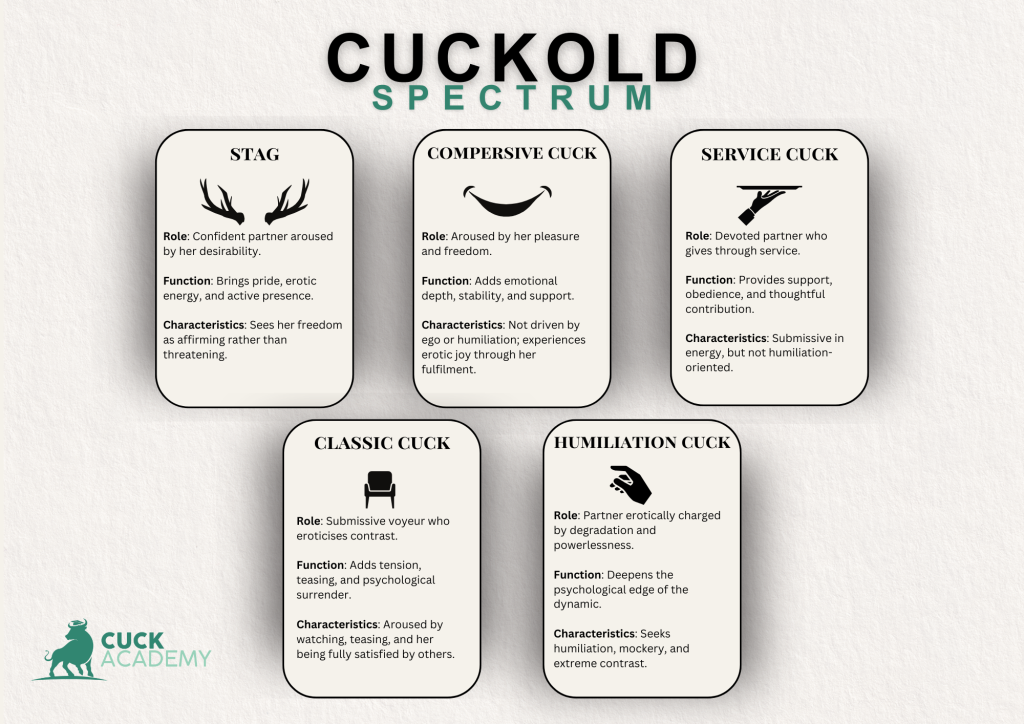
I’ve spoken before about the cuckold spectrum — service, humiliation, compersion, devotion, and I think it’s time we admit the same thing exists for cuckoldresses too.
At one end, you have softer hotwife dynamics. Reassurance-heavy. Emotionally centring the male partner. Sexual exploration framed as something risky or transgressive.
At the other end, you have women like me, and others who experience cuckolding primarily as power exchange. Authority. Sexual honesty. Desire without apology.
Not because we’re cold or unfeeling, but because we don’t believe attraction should be negotiated or diluted to preserve male comfort.
That doesn’t make one version more “real” than the other.
It just makes them different.
Who Gets to Be “Legitimate”?
What I do find curious, and occasionally tiring, is how often legitimacy is policed along gendered lines.
Men are allowed infinite nuance in their desires. Women are expected to fit a very specific emotional narrative in order to be taken seriously.
If we don’t centre male insecurity, we’re told we’re “just femdom.”
If we’re sexually fulfilled elsewhere, we’re told it doesn’t count.
If we’re honest about preferring alpha partners, we’re accused of undermining the dynamic entirely.
I don’t agree.
I don’t believe a woman has to marry or emotionally tether herself to someone she isn’t sexually fulfilled by in order for cuckolding to be valid. I don’t believe devotion requires romantic reciprocity, and I don’t believe prioritising sexual polarity is cruel.
I think pretending it doesn’t matter is far more damaging in the long run.
A Word That Has Always Evolved
Even the word cuckold itself has evolved.
Historically, it wasn’t consensual. It meant deception, ridicule, and a lack of agency. Modern cuckolding is already a reclaimed concept, reshaped by communication, consent, and choice.
So the idea that it has one fixed, eternal meaning doesn’t even hold up historically.
People will always have their definition, and that’s fine. We all make sense of desire in ways that protect us.
Personally, I enjoy the untangling. I enjoy finding language for the grey areas. I enjoy watching how people arrive at the same word through completely different emotional doors.
Cuckolding isn’t one thing.
It never was.
The moment we stop trying to make it behave like one is the moment the conversation actually gets interesting.
The post Different Dynamics, Same Word: A Woman’s View on Cuckolding appeared first on The Cuck Academy.